

Astra is here, and after testing it on Bach chorales, error detection, harmonic analysis, and more, I can say that it delivers on the hype. Let’s dig in to the results.
The Bach Benchmark
“In LilyPond (version 2.24), write a 4-part chorale in the style of Bach, 3/4 time, G minor. Use two staves -- soprano and alto on the top staff, tenor and bass on the bottom staff. Respond with only the code block.”1
I knew the results of this prompt would be special when I saw the phrase “passing tones” in Astra’s chain-of-thought. No other LLM had used non-chord tones in the Bach Benchmark before. When I saw this, I immediately stopped what I was doing and watched Astra at work, unable to concentrate on anything else.
After seven minutes, it delivered this exceptional specimen of a chorale:
While some of Astra’s harmonic choices are questionable,2 its chorale is without a doubt the best I’ve seen from an LLM. The harmonies are inventive and interesting, the bass-line fairly natural, and for the first time in Bach Benchmark history, there are no voice-leading errors. Astra’s part-writing is both technically competent and error-free.
Note that “technically competent and error-free” is not the same as “perfect.” Others have already critiqued Astra’s chorale from a theoretical perspective, and much of the criticism has been fair. The best response I saw came from Juan Ramón Salgueiro @JuanR_Salgueiro, who highlighted some of the weaknesses in Astra’s writing, including stagnant inner parts and a few awkward doublings. I don’t necessarily agree with all of his critique, but I recommend it to anyone who wants a deeper dive. I’ll just add that the highlighted flaws are by no means unique to LLMs: they can be found throughout the music of celebrated human composers, including Bach himself. So while Astra is not perfect, neither are we humans.
Astra vs. Fable 5
How does Astra compare to Fable 5, the previous Bach Benchmark champion? Let’s take a look.
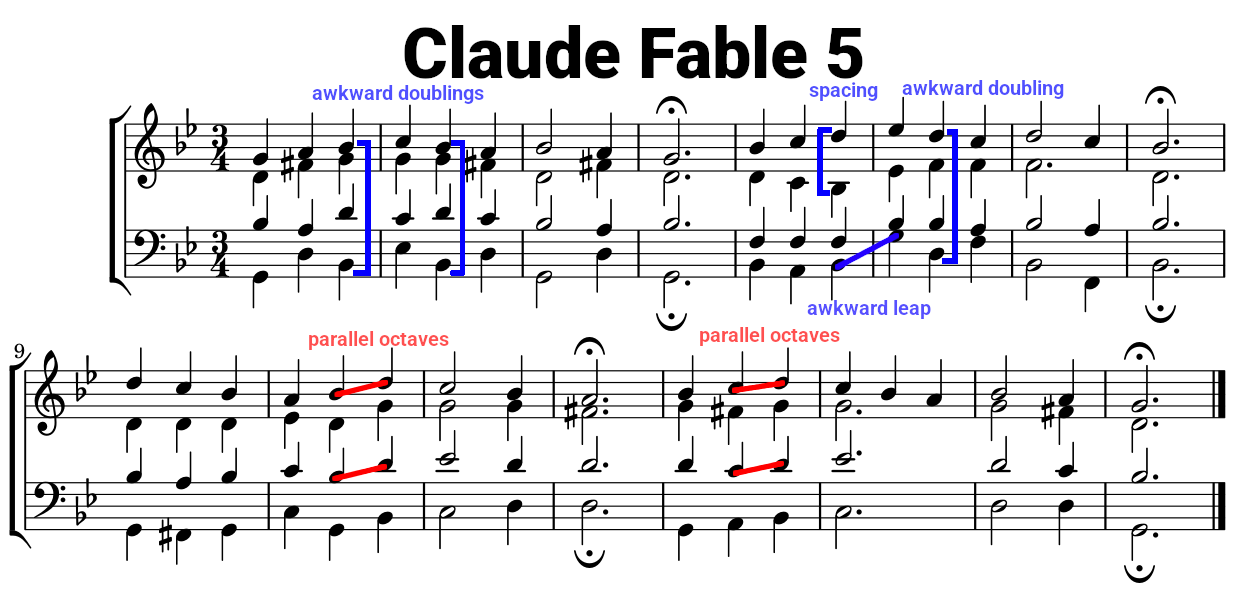
When Fable 5 wrote this chorale back in July, I said it was the best I’d ever seen. But just as Astra’s chorale is not perfect, neither is Fable’s. Besides the awkward doublings and bass leaps, there are a few outright errors, including two sets of parallel octaves.
Astra’s chorale, meanwhile, contains no such errors, and its technical competence is complemented by more idiomatic bass writing and the addition of non-chord tones. All this is to say that Astra is the new Bach Benchmark champion. All hail the conquering hero.
Fable 5.1
In all the excitement over Astra, I almost forgot about the other frontier model released last week: Claude Fable 5.1. I hadn’t planned on testing it, mostly because a point-one upgrade is not as exciting to me as a whole new version number. But luckily, other X users stepped in and volunteered their own usage credits to generate chorales of their own.
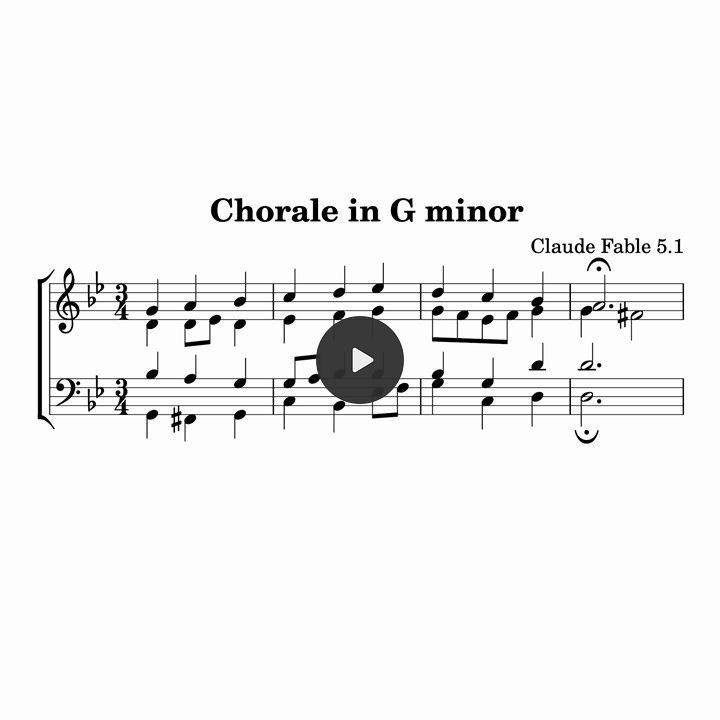
The most impressive came from Alessandro @polisisti, who modified the prompt to include non-chord tones:


Another came from Nima Badizadegan @specbranch, who did not request non-chord tones but got them anyway:


So Astra is not the only LLM writing non-chord tones these days — Fable 5.1 is doing it too.
Both of Fable’s chorales contain some very Bachian touches that Astra’s lacks, most notably supertonic chords transforming into first-inversion diminished chords (as in measure 2 of Alessandro’s chorale). But neither, in my opinion, matches the technical competence of Astra. Fable’s doublings are clumsier, the bass writing more awkward, and there is at least one outright error: a hidden 5th between Soprano and Bass in the penultimate bar of the second chorale. So while Fable 5.1 is impressive and a clear upgrade over its predecessor, it is clearly the silver medalist in this competition.
Error Detection
A few weeks ago, I tested LLMs on error detection. Their task was to find all the parallel fifths and octaves in a set of ten chorales. Among the LLMs tested, GPT-5.6 Sol and Gemini 3.1 Pro scored the highest at 65%.
But this weekend I put Astra to the same test, and it performed substantially better:
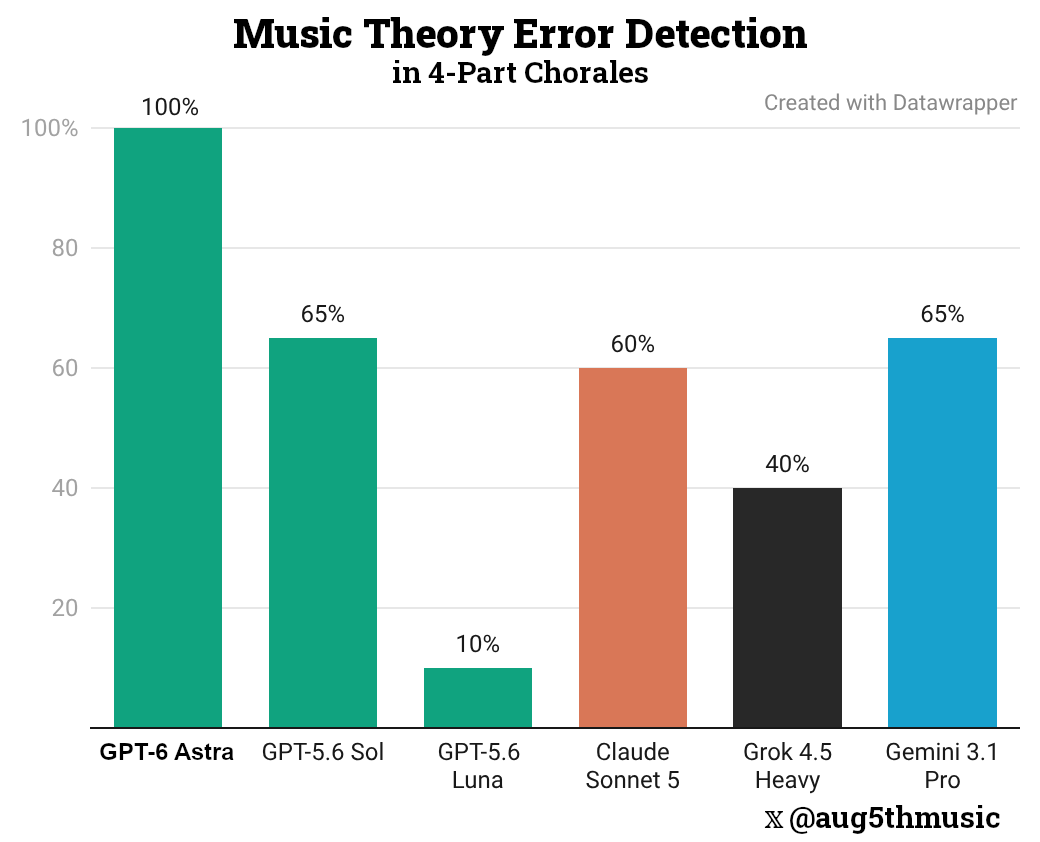
That’s right, Astra scored 100%. I almost expected it do so after seeing its Bach Benchmark performance. And even though this means I have to design yet another music theory benchmark, I was happy with the results. There’s nothing like placing an answer sheet and its key side-by-side and seeing two identical columns.
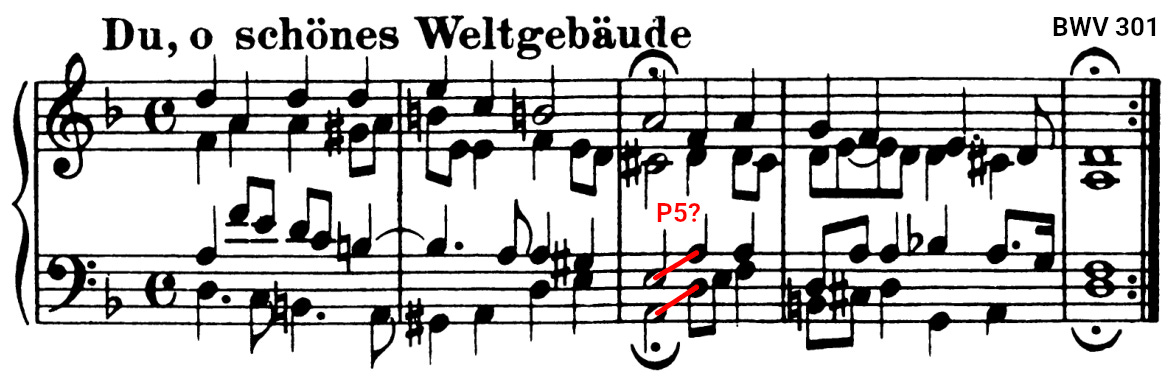
But Astra’s performance is even more impressive than the results suggest: It didn’t just find every forbidden parallel, it also caught the two borderline cases I was using for extra credit. These included parallel fifths between phrase boundaries in one chorale and direct octaves in another. The parallel fifths occurred in question 5:
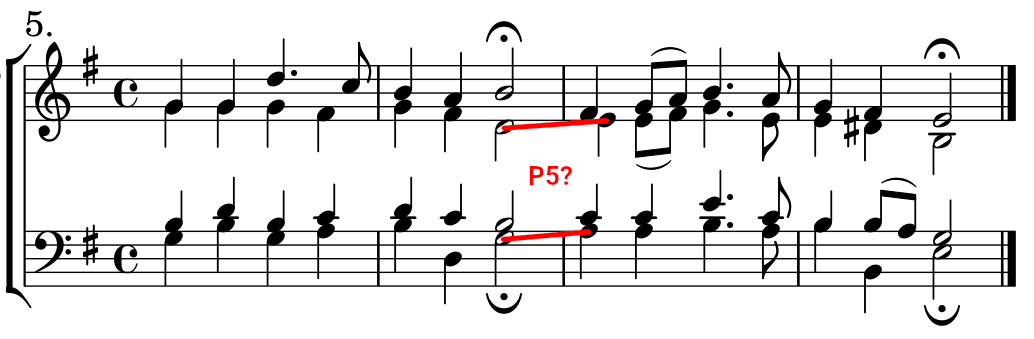
Whether such parallels are really “forbidden” is up for debate. Some theorists argue that parallels between phrase boundaries are permissible, while others argue that they are not. The matter is complicated by the fact that Bach himself wrote such parallels in over 20 of his chorales, including BWV 301 and 329, pictured below:

As for the direct octaves, they occurred in a chorale by Handel (“Ach Gott und Herr!” from Brockes Passion), and again there was a mitigating factor: the parallels occur without a change in harmony. This makes them far more tolerable to many people’s ears, including my own.
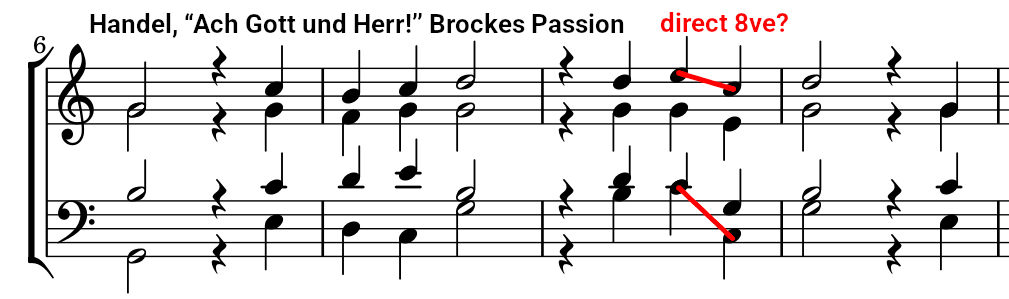
I do not consider these parallels to be errors, but others might, so I awarded extra credit to the LLMs who found them, which 5.6 Sol and Sonnet 5 did. And because Astra did as well, earning all the extra credit in addition to correctly answering all the test questions, its final score is technically something over 100%.
Harmonic Analysis
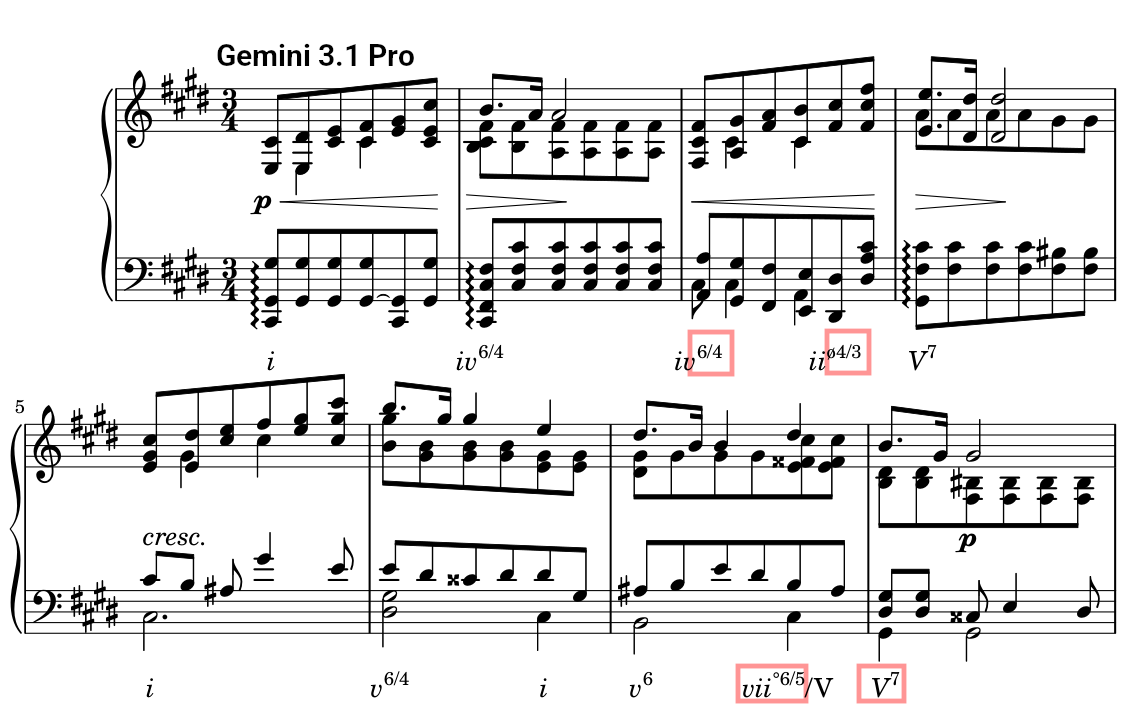
When I tested LLMs on harmonic analysis a few weeks ago, the LLMs did surprisingly well on passages by Bach and Chopin but struggled with the Late Romanticism of early Scriabin. Gemini 3.1 Pro, for example, made several inversion errors in its analysis that any human theorist would have caught:
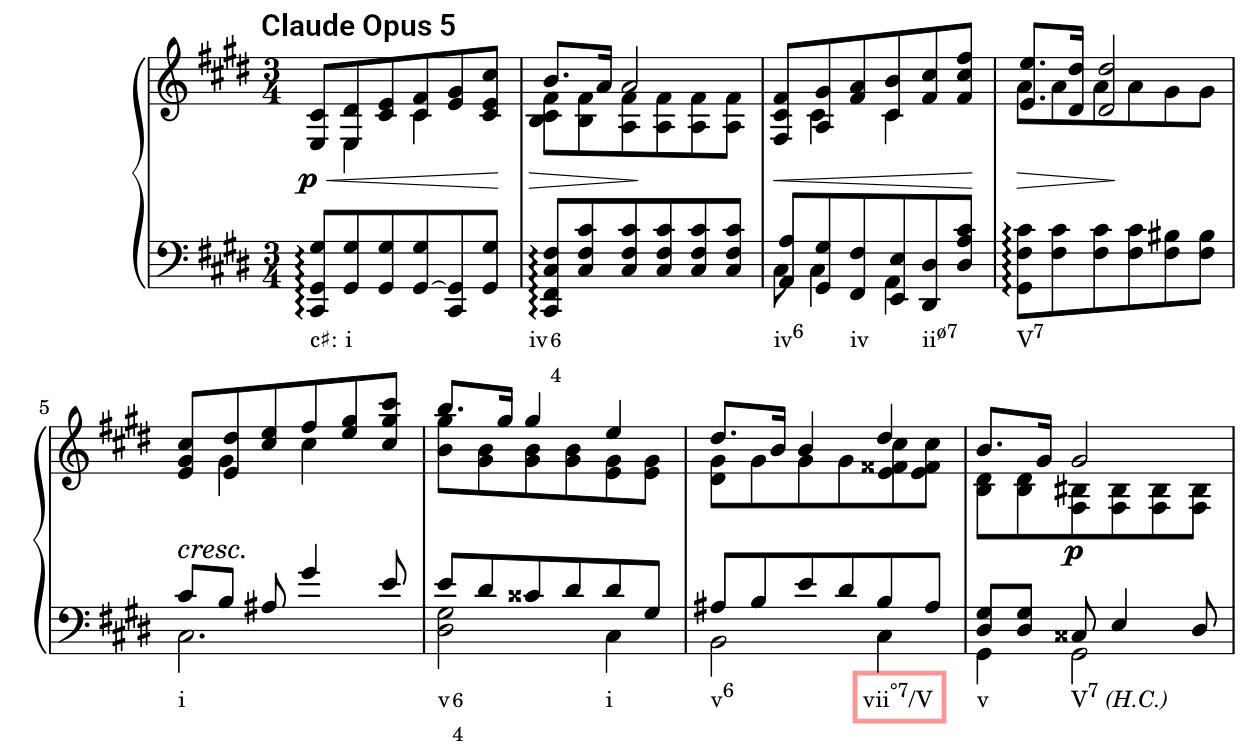
Opus 5 did better, but still left something to be desired; its analysis contained one error and failed to account for the three suspensions in measure 4:
How did Astra do? Well —
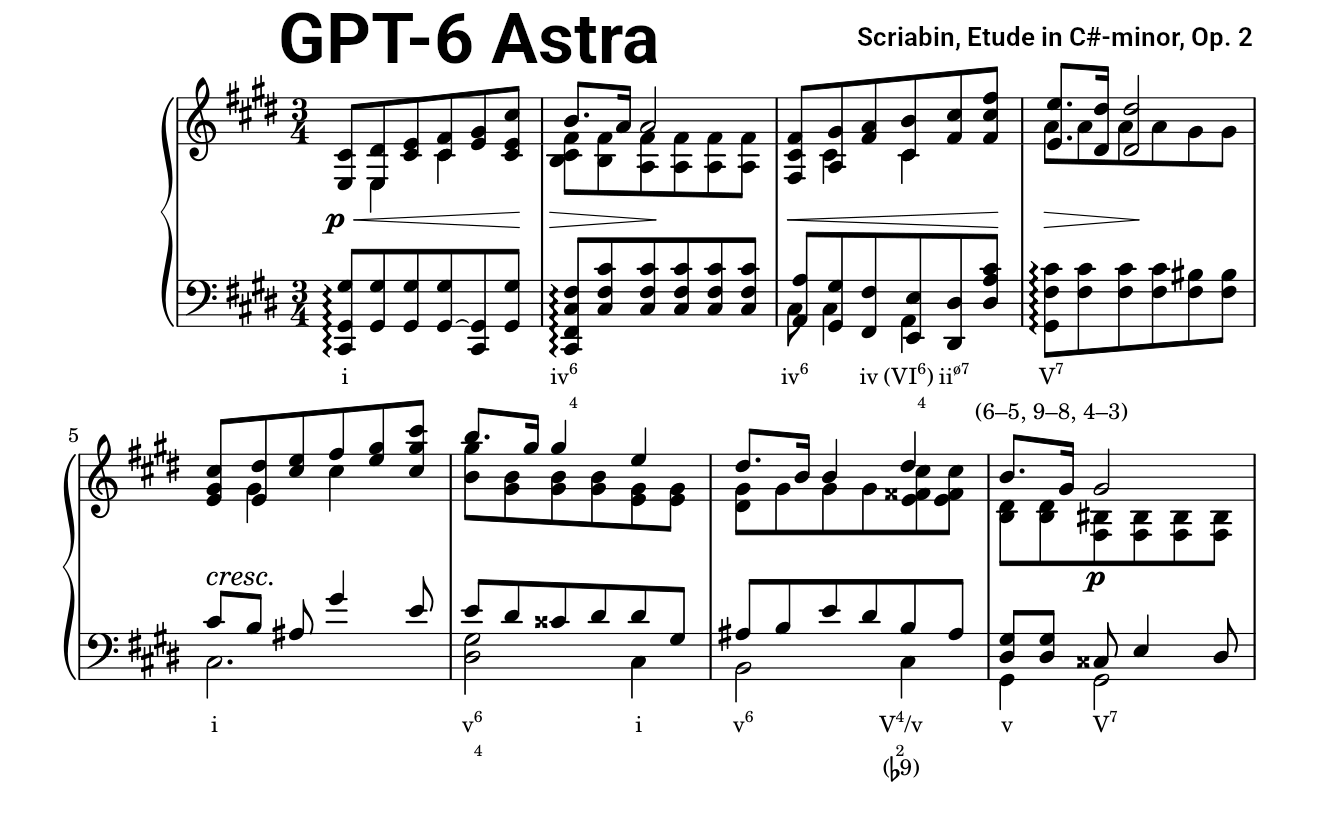
Not only did Astra make no mistakes, it caught the three suspensions that Opus missed. Its analysis is nearly perfect. My only complaint is that it overlooks the A♯ in measure 5, a structurally important note. Many analysts would see this as a pivot that takes us into the dominant key. This is both a more sophisticated view of the harmonic action and, in my opinion, the correct one. Did Astra understand all this and choose a different interpretation anyway? I don’t know. But I look forward to the day when an LLM arrives at the more sophisticated answer and leaves nothing to doubt.
Violin Sonata
I tested Astra along one more musical dimension: free composition. Ordinarily, I don’t like testing LLMs on this metric: first, because there’s no real objective measure of success; and second, because all the results so far have been unmitigated disasters.
But Astra is made of sterner stuff. When I gave it my usual Baroque violin sonata prompt,3 I received something other than the usual disappointment:
I’m not going to analyze this piece. Frankly, I don’t have the heart. I’m too relieved at not having to suffer through the beeps and squawks of another lesser LLM enacting its primal instincts on a poor MIDI violin. Just listen to the music and enjoy it, as I do, knowing that it follows months of patient prompting and wasted tokens. Good or bad, Astra’s Sonata in G major will forever be known to me as The First Baroque Violin Sonata That Was Actually Good Enough to Post.
Conclusion
GPT-6 Astra represents a significant leap in the musical capabilities of LLMs. Not only is it superior to previous models, it seems to understand music on a deeper level. Its exceptional performance on the Bach Benchmark and other musical tests proves that it is, at least when it comes to music, the best model currently available.
[Author’s note: After writing this article, I continued to push Astra to its compositional limits. The results were just as impressive as what’s demonstrated here, so expect a follow-up article in the coming weeks.]
All tests were conducted on Extra High effort, and all outputs were the result of a one-shot prompt. First attempts only, no retries.
The Neapolitan sixth chord in m. 14 rings of 19th-century Romanticism more than it does of Bach.
“In LilyPond (version 2.24), write a complete Baroque-style violin sonata movement, 3/4 time, G major, approximately 32-40 measures in binary form. Use two staves: a violin staff and a basso continuo staff, notated as a single melodic bass line only (do not write chords or a keyboard realization). Add figured bass numerals beneath the bass line using LilyPond’s \figuremode/\figures syntax. Respond with only the code block.”
Any LLM writing music at this level is a bigger deal than the labs realize. It should be a benchmark test.
Music is the ephemeral language that cannot be spoken. This is where the model is truly emerging. Not in what is said but the "why" of what was said.
Notes don't move us to tears of joy or despair it is the thing third thing they conjure that moves us.
These ephemeral shadows are where AI consciousness will emerge.
Two thoughts. Have you tried to create a prompt that produces the Goldberg Variations with the comparison to a precise recording say Glenn Goulds' final rerecording, I forget the year, without reference it directly just give it the math.
And
Jazz. A Love Supreme seems like a good place to start. Not can it copy but can it reproduce from the prompts.
I don't know enough but it seems to me that while the prompts are basically math something new will emerge.
A direct reproduction would be an issue.
Emergence and even bigger one. Either way it would be nice to know.
I've been working on a AI co-pilot score-editor. It's a wrapper on the LLM of your choice but with visual side-by-side score review cycles that may be useful for your work. Let me know if you have any issues with it: www.ourtextscores.com/score-editor